
Buy framed posters online - choose the right one
An empty wall between the sofa and the window is rarely just empty. It can make a room seem unfinished—or become a surface that gives it character, depth, and a personal touch. Therefore, those who want to buy framed posters online don't just choose a motif. Size, frame, and finish all work together to determine whether a beautiful picture becomes a harmonious piece of interior design.
The great advantage of a pre-framed poster lies in its simplicity: choose a motif, select a frame to suit the room, and receive it ready to hang. This saves you the hassle of searching for a separate print, the trip to the framer, and the uncertainty of whether the dimensions, glass, and hanging hardware will actually work together. Especially in carefully furnished living spaces, vacation homes, or offices, this simplicity is not a minor detail, but rather an integral part of a successful result.
Buy framed posters online: The overall picture is what matters.
A picture can be compelling in itself, yet still appear too small, too dominant, or stylistically chaotic on the wall. Therefore, the selection process doesn't begin with choosing a motif you like, but rather with considering the room itself. What colors dominate the carpet, sofa, and curtains? Are there already dark accents, light woods, or brass details? And from where will the picture be viewed most frequently?
In spacious living areas, wall art can make a statement. A large-format coastal view, an architectural photograph of New York, or an abstract motif can focus the eye and lend a sense of calm to an open space. In a narrow hallway or above a side table, a vertical format often works better. Above a sideboard or bed, a horizontal format creates a natural connection to the piece of furniture.
Proportion is often more important than a supposedly safe standard size. A poster that's too small can quickly look lost on a wide wall. Conversely, a very large image in a compact room can lose its impact if there's too little distance to view it. As a guideline, a picture above a piece of furniture should occupy roughly two-thirds to three-quarters of its width. This isn't a rigid rule, but it's a reliable starting point.
The hanging height also affects the overall impression. Often, the best effect is achieved when the center of the picture is roughly at eye level. Above a sofa, bed, or console table, the artwork can be hung slightly lower so that it remains visually connected to the furniture. When combining several pictures, it's ideal to treat them as a single composition and not to position each piece individually.
The motif sets the mood
Wall art is one of the most direct ways to give a room an atmosphere. A beach scene with a clear horizon line creates a sense of spaciousness and lightness. Hamburg recording It can appear urban, familiar, and elegant all at once. Motifs from Saint-Tropez, California, Florida or the Hamptons bring the memory of light, architecture and coastal life into an interior, without the room having to be decorated thematically.
The key is how clearly the motif should speak for itself. Those designing a calm, timeless space will often find that minimalist landscapes, soft color palettes, or abstract compositions are a better choice. They complement materials and furniture rather than competing with them. Photographs with strong contrasts, iconic architecture, or vibrant colors, on the other hand, are suitable as a deliberate statement – for example, above a minimalist sofa, in an entryway, or in a home office.
A common thread may be discernible in several images, but it doesn't have to consist of an identical color palette. Two coastal scenes can be linked by light and atmosphere, a cityscape and an abstract work by a shared framework.Too many different visual languages in a small space, on the other hand, quickly look like a random collection. Here, it helps to give a wall a clear theme: travel memories, coastal tranquility, urban energy, or graphic abstraction.
Destinations as a design accent, not as a backdrop
Site-specific photographic art appears particularly high-quality when it is not treated like a souvenir. An elegant Photo of Sylt A scene from New York doesn't necessarily have to be combined with nautical accessories or urban decorative elements. The contrast can be particularly striking: a breezy beach scene in a modern city apartment, or an architectural photograph in a historic building with warm materials.
Choose an image that conveys a mood you actually want to experience in the room. A tranquil morning by the sea is perfect for the bedroom. A dynamic street scene adds energy to the workspace. In the dining room, a motif that has a clear impact even from a distance and can stimulate conversation works particularly well.
Properly arrange frames, photo paper, and acrylic glass
The frame is more than just a border. It determines whether a poster appears graphic, warm, classic, or modern. A narrow black frame creates contrast and gives photographs a precise, contemporary look. Light wood tones create a softer, more natural effect. White or understated frames make light-colored images appear light and airy, while darker frames can add more weight to an image.
What's important isn't just the color, but its relationship to the room. A black frame doesn't have to match black furniture—it can also complement door handles, light fixtures, or window frames. Wooden frames harmonize with parquet, oak, or linen flooring, but can differ in shade. Too precise a match can sometimes look contrived; a harmonious set of materials is usually more elegant.
Print quality also determines whether an image will be convincing in everyday use. High-quality photo paper ensures nuanced colors, visible details, and a surface that gives the photograph depth. The difference is particularly noticeable in photos with skies, water, architecture, or subtle shadows: gradations remain clear instead of appearing flat or grainy.
Acrylic glass complements this impression with a clear, modern protective layer. It is lighter than traditional glass and therefore well-suited for larger formats. Depending on the location, however, you should still pay attention to lighting. Reflections can be a problem with any glass picture if it is placed directly opposite a large window. In this case, a slightly offset placement on a side wall or a motif with a calmer, somewhat darker background can help.
Ready to hang means: The details have already been resolved.
A framed poster only truly shines when it arrives thoughtfully prepared. This includes a well-made frame, a sturdy backing, and suitable hanging hardware. This way, ordering a frame remains a decorating decision rather than a weekend project involving a trip to the hardware store and improvised mounting.
At Cosman Photocollection, the images are printed on high-quality photographic paper, hand-framed, and supplied with hanging hardware. This combination of curated selection and professional framing is particularly useful if you're looking for a format that doesn't conform to standard poster sizes. Size and frame can thus be considered as a single unit from the outset.
Single image, duo or gallery wall.
A single large-format picture is the right choice if the wall is to play a clear leading role. It creates a sense of calm, is quickly taken in, and gives a strong motif enough space.Above the sofa, in the stairwell or in a spacious entrance area, this solution looks particularly sophisticated.
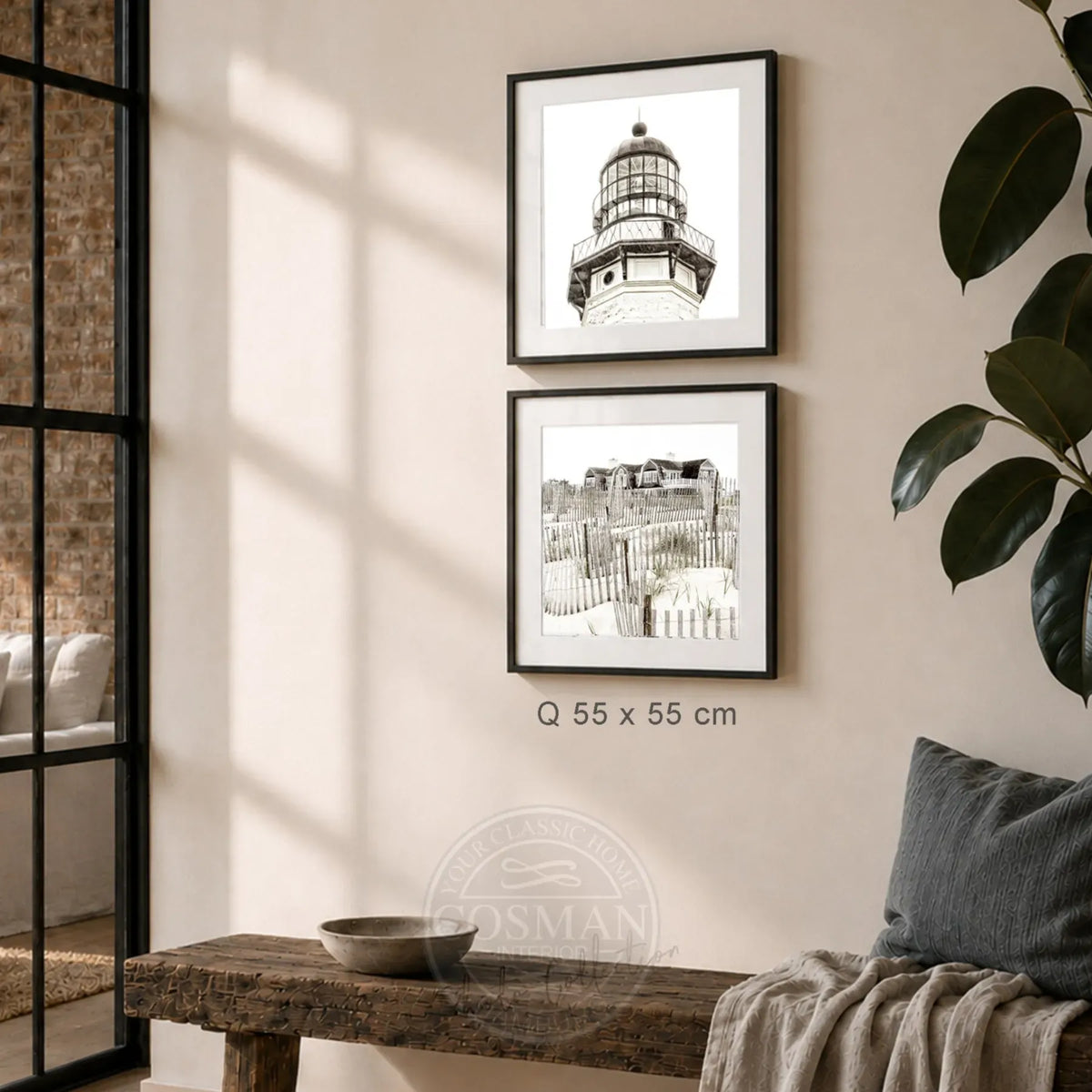
A duo is suitable if you like symmetry or want to divide a large surface. Two related motifs in the same format and frame create order without appearing austere. This could be a pair of coastal shots, two architectural perspectives, or a combination of photography and abstraction with shared color palettes.
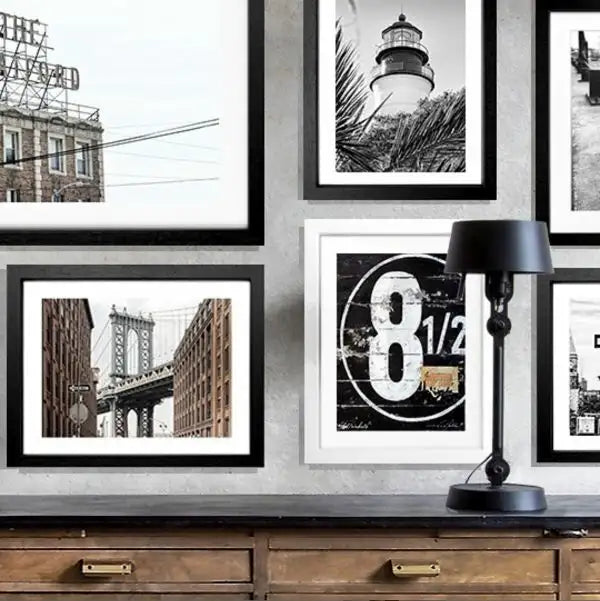
A gallery wall requires a bit more planning, but it rewards you with personality. Instead of adding pictures haphazardly, first choose the largest image and arrange the others around it. Using the same frames creates a sense of harmony between different images. Different frames can work well if they deliberately stay within a consistent palette—for example, black, natural wood, and a subtle light tone. Test the arrangement on the wall with paper cutouts before hanging the pictures. This takes only a few minutes and prevents unnecessary drilling.
Make three decisions before ordering
First, measure the available wall space and the furniture underneath. Then, choose the image based on the desired atmosphere of the room, not just on the screen. Finally, select the frame as a unifying detail for your interior. Following this order will lead to significantly more confident decisions than someone who first chooses a favorite image and decides on the rest later.
Also consider the viewing distance. Fine photographic details can be taken at a large size if you can step back a few steps. In small rooms, clear compositions are often more effective than scenes with a lot of intricate details. And if a picture is intended for a vacation property or a commercial space, it's worth choosing a subject that remains easily accessible to changing guests or customers.
A wall doesn't need to be completely decorated to look stylish. A single, carefully chosen, high-quality framed poster can bring a room together, evoke a travel memory, or instantly give a new home its own unique character. So take a moment to consider the image and size – the effect will be visible every day.