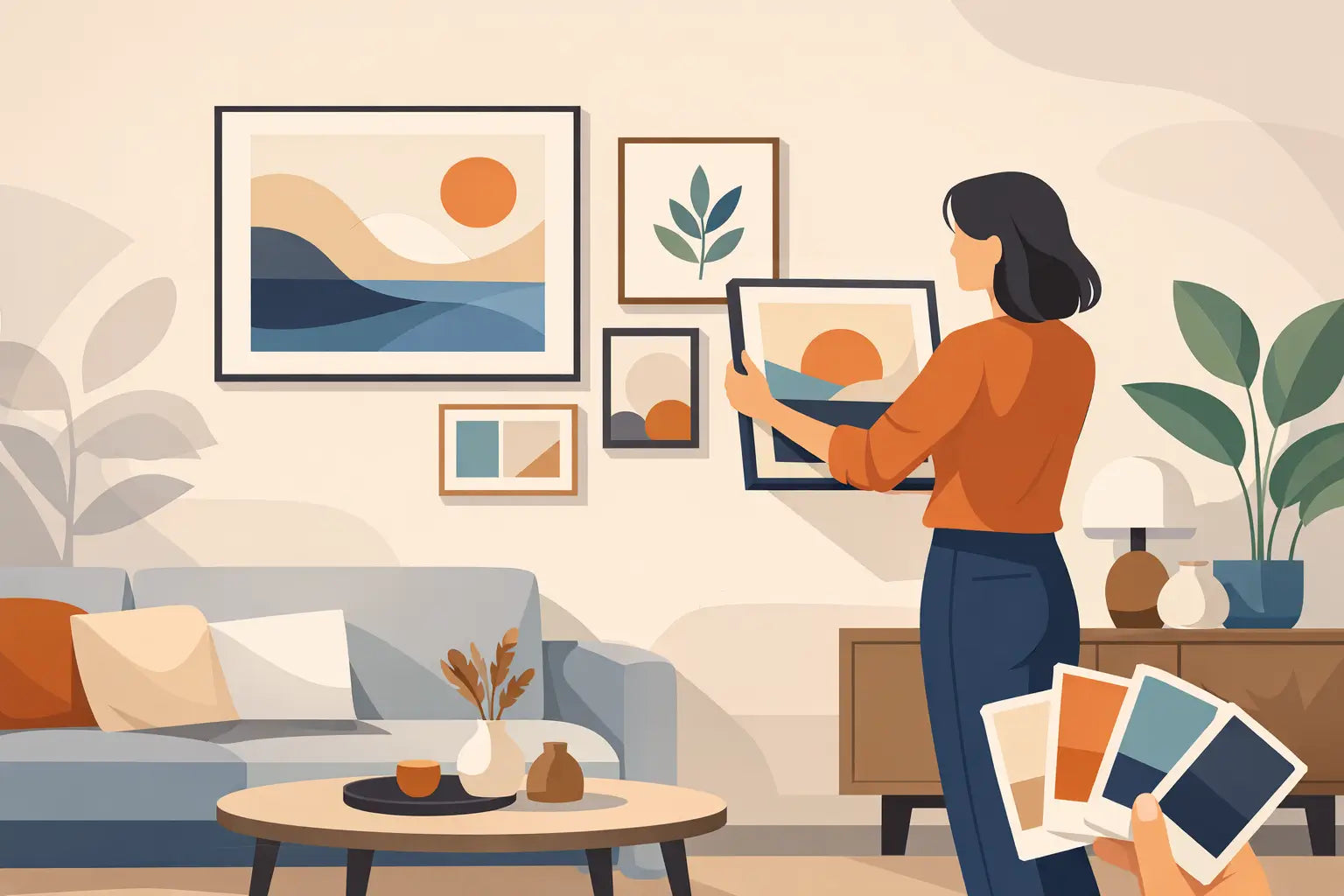
Choose art prints for rooms with character
An empty wall above the sofa is rarely just an empty wall. It plays a key role in whether a room feels fully furnished or whether it still lacks a personal touch. Art prints They create this difference with relatively little effort - provided that the motif, size and framing are consciously chosen.
Unlike a small poster that gets lost somewhere among furniture, a high-quality framed print can draw the eye in a room. It brings travel memories, light, color, and a specific mood to the wall. Beach scene from Sylt It can radiate calmness; a New York photograph gives urban energy to a clean interior, while an abstract motif incorporates colors and shapes from the room without becoming too concrete.
Art prints as a complete furnishing solution
An art print doesn't have to seem like a spontaneous decorating idea. When executed correctly, it's a precise design element: tailored to the room, its proportions, and the desired style. Especially on larger walls, it's not just the image itself that matters, but the entire presentation. Photographic paper, mat, frame profile, and glazing all work together.
This is also the difference between an unframed print and a ready-to-hang wall art piece. Ordering a design, then searching for a suitable frame, and finally having to organize mounting hardware involves making many small decisions with uncertain results. A hand-framed art print with pre-installed hanging hardware eliminates this hassle and creates a harmonious overall look right from the start.
This is particularly convenient for living rooms, vacation homes, or prestigious workspaces. Wall decoration doesn't become a project lasting several weeks, but rather a straightforward decision: choose a motif, determine the format, select a frame, and hang it up.
The subject matter determines the atmosphere.
The best choice doesn't begin with the frame, but with the question: What mood should the room evoke? A picture doesn't have to repeat all the colors of the room. Often, it has a stronger effect when it creates a deliberate contrast or elegantly picks up on an existing nuance.
Coastal scenes evoking tranquility and vastness
Photographs of coastlines, dunes, boats, or open horizons lend a sense of spaciousness to a room. They pair particularly well with natural materials such as linen, wood, rattan, and light-colored carpets. In a bedroom or vacation apartment, a large-format beach print often creates a calmer atmosphere than a gallery of many small pictures, because it lends the wall a clear, understated presence.
It all comes down to the visual language. Soft sandy tones and a bright sky blend harmoniously into minimalist Nordic interiors. A high-contrast motif featuring a deep blue sea or striking waterfront architecture, on the other hand, can be more prominent and become the focal point of the room.
Cityscapes for a clear, urban accent
New York, Hamburg, or Saint-Tropez represent different forms of city life. Hamburg recording With its harbor lights and wide-open skies, it combines local identity with understated elegance. Architectural Images from New York They bring structure to rooms with clean lines, darker woods or modern lighting.
It's important to remember that city photography doesn't have to feel cold. Sunlight on facades, a quiet street, or a view across the water can make urban art prints feel inviting. They're a great choice for dining rooms, hallways, home offices, and commercial spaces where personality is welcome without creating a cluttered atmosphere.
Abstract art prints for color without a fixed theme
Abstract motifs are particularly useful when a room needs color but shouldn't depict a specific landscape or cityscape. They can incorporate a single tone from cushions, curtains, or rugs, thereby bringing order to a complex interior.
The advantage: Abstraction remains open to change. If new furniture or textiles are introduced, a well-chosen painting can still work. This is especially true for works with a neutral base and carefully selected accent colors. Very dominant color fields can look fantastic, but require a deliberately calm environment.
The right size makes all the difference.
Many walls are decorated with pictures that are too small. A 30 x 40 cm print might look beautiful on a sideboard, but it gets lost above a wide sofa or on a high wall in an older building. As a guideline, a single picture above the sofa should occupy approximately two-thirds to three-quarters of the furniture's width. With a 240 cm wide sofa, a picture or a group of related pictures measuring around 160 to 180 cm wide creates a harmonious effect.
Wall art above a dining table can be more expansive, especially if the table stands freely in the room. In a hallway, however, the sightline is key: a vertical format can visually lengthen a narrow space, while a horizontal motif calms a long corridor.
Custom sizes are a compelling solution when standard dimensions don't suit the architecture. A perfectly sized panorama above a bespoke sideboard, between two windows, or on a wall with an unusual niche looks significantly more sophisticated than a picture placed haphazardly. Before ordering, it's helpful to mark the desired size on the wall with painter's tape. This makes the height, width, and distance to furniture immediately apparent.
Choose frames and acrylic glass carefully
The frame gives an art print its presence. It can subtly complement a motif or deliberately frame it graphically. A narrow black frame accentuates modern architecture, black-and-white photography, and high-contrast cityscapes. Oak or other light wood tones bring warmth to living rooms and bedrooms. White frames recede visually and are well-suited to light, airy color schemes.
Not every combination has to be strictly tone-on-tone. A warm wooden frame can make a cool photograph of the sea feel more inviting. A dark frame adds more definition to a bright beach scene. The crucial point is that the frame establishes a relationship with at least one element in the room – such as the floor, lamps, furniture handles, or other picture frames.
Acrylic glass is an elegant and practical choice for wall art. It protects the print and provides a high-quality, clear surface without the weight of traditional glass. This is a significant advantage in homes with children, vacation properties, or high-traffic areas. However, wall art should not be exposed to direct sunlight for extended periods to ensure the colors remain vibrant over time.
Single picture or gallery wall.
A large-format single image is ideal when a room needs a clear focal point. Placed above a bed, sofa, or console table, it creates a sense of order and spaciousness. Photographs featuring horizons, architecture, or strong color fields particularly benefit from this calming effect.
A gallery wall is more suitable when different places, perspectives, or memories are to be connected. To make it appear curated rather than random, it needs a common element: similar frames, a recurring color palette, or an overarching theme such as coastline, cityscape, or abstract forms.Different formats are possible, but the spacing should remain consistent. A gap of 5 to 8 cm between frames usually looks calmer than large gaps.
A gallery wall isn't necessarily too much for small rooms. It just shouldn't consist of many tiny prints. Three to five well-proportioned prints with uniform frames can give a narrow wall more depth without overwhelming it.
Ready to hang instead of improvised
Even an excellent image loses its impact if it hangs crooked, is placed too high, or the frame doesn't match the wall. As a rule of thumb, the center of the picture in living areas should be roughly at eye level. Above furniture, there should generally be a gap of 15 to 25 cm between the edge of the furniture and the bottom of the frame. With very high ceilings, a picture shouldn't automatically be hung higher – it should still blend in with the rest of the room.
Ready-to-hang art prints not only save time but also reduce uncertainty. High-quality photo paper, careful framing, acrylic glass, and the appropriate hanging hardware combine to create an object designed for the wall from the very beginning. Cosman Photocollection combines this standard with curated images from Hamburg and international destinations, custom formats, and handcrafted frames.
Anyone planning to hang multiple pictures should first lay them out on the floor or test them on the wall using paper samples. This small step prevents good images from ending up too close together, too far apart, or outside the ideal viewing height.
Wall art should fit into life.
The selection process isn't about finding the supposedly perfect art print forever. Rooms change, as do homes, furniture, and preferences. What's crucial is a motif that now establishes a credible connection to one's own life: a view of the sea, a city that holds significance, or an abstract work whose colors perfectly unify the space.
Therefore, don't just choose any image for a blank space. Choose a view that you'll be drawn to upon arrival.